
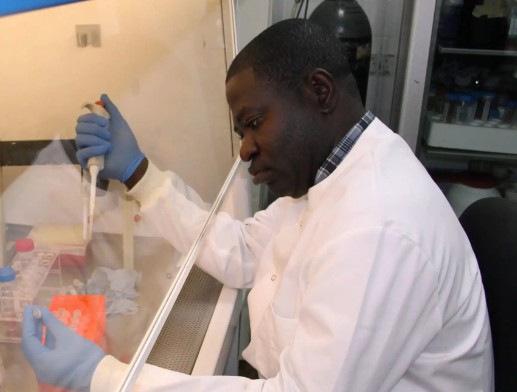
Associate Professor at the Department of Theoretical and Applied Biology at the Kwame Nkrumah University of Science and Technology, Kumasi (KNUST), Prof. Kingsley Badu, has highlighted the potential of artificial intelligence (AI) to transform mosquito surveillance and strengthen disease prevention efforts.
Speaking at the KNUST Libraries' ScienceFriday programme on the theme, "Listening to Mosquitoes: Translating Flight Sounds into Data for Disease Monitoring," Prof. Badu demonstrated how AI and bioacoustics can be harnessed to improve mosquito surveillance and strengthen public health interventions.
He said scientific discoveries should extend beyond academic publications to deliver practical solutions that directly benefit communities.
"It's not only an opportunity for science, but also an opportunity for some education," he said. "It's important that science is communicated so that whatever science we are doing in the lab and how it can potentially support our society is essential."
Prof. Badu said the project's objective was not simply to produce scientific publications but to ensure that research findings translated into meaningful public health interventions.
"The interest is not just publishing scientific papers and forgetting about it. It's something that we are pushing forward, that this action is translated into action in the communities so that we can actually see the relevance of the work we are doing in the lab," he said.
He introduced participants to an AI-powered mosquito surveillance system developed by KNUST researchers, explaining that understanding mosquito behaviour is essential for effective disease control.
"The behaviour of the mosquito is what will tell you what kind of interventions you can use. If you don't know the behaviour of these mosquitoes, your intervention will not make sense," he said.
Prof. Badu demonstrated the AI-powered mosquito surveillance system, which uses wingbeat sounds to identify mosquito species and characteristics.
"We have been able to convert the flight tones into data and also convert mosquito images into data. Our aim is to develop an intelligent mosquito surveillance system that uses bioacoustics," he said.
He also introduced a mobile application that uses AI to identify mosquito species from photographs. He said the application and the sound-based surveillance technology would eventually be integrated into a fully automated mosquito surveillance platform to support disease monitoring in Ghana.
Prof. Badu said the system combines bioacoustics, image recognition and machine learning to identify mosquito species rapidly and accurately, with the long-term goal of strengthening vector surveillance and informing disease control strategies.
He attributed the project's progress to interdisciplinary collaboration among biologists, engineers, computer scientists, mathematicians and physicists, as well as the contributions of students, research collaborators and funding partners.
Story: Akosua Konadu Bandoh


